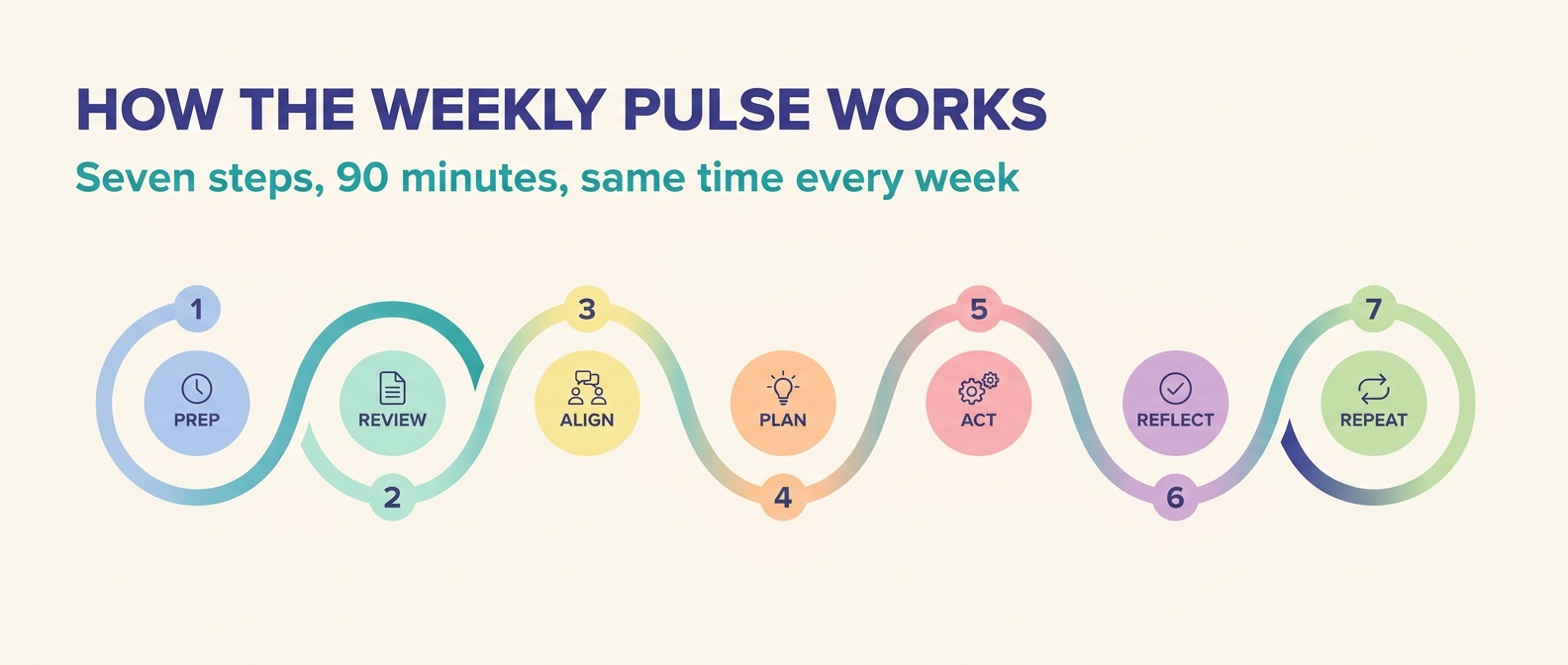
The Weekly Pulse is our version of the EOS “Level 10” meeting: a single, repeatable meeting that keeps two people rowing in the same direction. For just the two of us it runs ~30–45 minutes (not the full 90 a bigger team needs). Same day, same time, same agenda, every week. You don’t redesign it; you just run it. Below is what each of the seven steps is for, then hit Run the meeting to actually do it.
The seven steps
1 Segue ~5 min
Each person shares one personal win and one business win from the week.
Why: it gets you out of “inbox brain”, reconnects the two of you as people, and starts on a positive. It’s the on-ramp; nothing gets solved here.
- Keep it short: a sentence each.
- No problems yet. Wins only.
2 Scorecard ~5 min
Review your handful of weekly numbers (5–15). Each has an owner and a goal. Every number is simply on-track or off-track this week.
Why: numbers give you an early-warning system instead of finding out a month late. You’re not discussing them here; just reading them.
- Anything off-track? Don’t debate it. Drop it onto the Issues list for step 6.
- Good starter numbers for us: demo sites deployed, emails sent, replies, calls booked, £ collected.
3 Rock Review ~5 min
Rocks are your 3–7 most important priorities for the 90-day quarter. Go down the list; each is on-track or off-track.
Why: rocks are how big goals actually get done: a few priorities per quarter, not twenty. This keeps them visible weekly.
- Off-track rock → it becomes an Issue to solve, not a guilt session.
- Set rocks once per quarter; just review them weekly.
4 Headlines ~5 min
Quick customer & partner headlines: one-liners. “Cafe replied, wants a call.” “Alberto’s Mail Lead access sorted.”
Why: share the signal without a 20-minute tangent. Bullet points, not stories.
- Needs a decision or discussion? → drop it to Issues.
5 To-Do Review ~5 min
Review last week’s to-dos: the 7-day commitments. Each is done or not done. Aim to clear ~90%.
Why: this is the accountability engine. Small, specific, one-week actions: the things that actually move the business.
- Not done two weeks running? → make it an Issue.
- A to-do is a one-week action; a Rock is a 90-day priority.
6 IDS: Identify, Discuss, Solve ~20–30 min
The heart of the meeting. Take your Issues list (everything dropped in from steps 2–5), prioritise the top 3, and solve them one at a time.
Why: this is where the real work happens. Identify the true root issue, Discuss it once, Solve it. Every solve becomes a new to-do with an owner.
- Solve #1 completely before touching #2.
- “Discuss” ≠ take turns talking; get to the root, then decide.
- Most issues end as a to-do owned by one person.
7 Conclude & Rate ~5 min
Recap the new to-dos, confirm any messages to send, then each person rates the meeting 1–10.
Why: the rating is your feedback loop. Below 8? Say why in one sentence: that’s next week’s first improvement.
- Recap every to-do + owner out loud.
- Rating is instant and honest; don’t explain it away.